From scattered inventory to a dashboard-backed distribution system.
I built a Smartsheet-based inventory dashboard to track value, locations, quarterly distribution, and donation progress for $1.1M in sports equipment moving across Los Angeles.
One person, scattered assets, no central tracker.
The starting point was not a messy dashboard. It was no dashboard at all: more than a million dollars in sports equipment spread across Los Angeles warehouses, with inventory state, value, and distribution context living in fragmented places.
I turned that into a practical operating view using the original stack: Smartsheet, Workday, Salesforce, and Agiloft. The dashboard made inventory value, donation value, location notes, and distribution reports visible enough to act on.
Single-Pane Logistics & Distribution Architecture.

Before: Ground-Level Logistics Context
The work started in storage rooms and warehouse context, before the dashboard made the system visible.
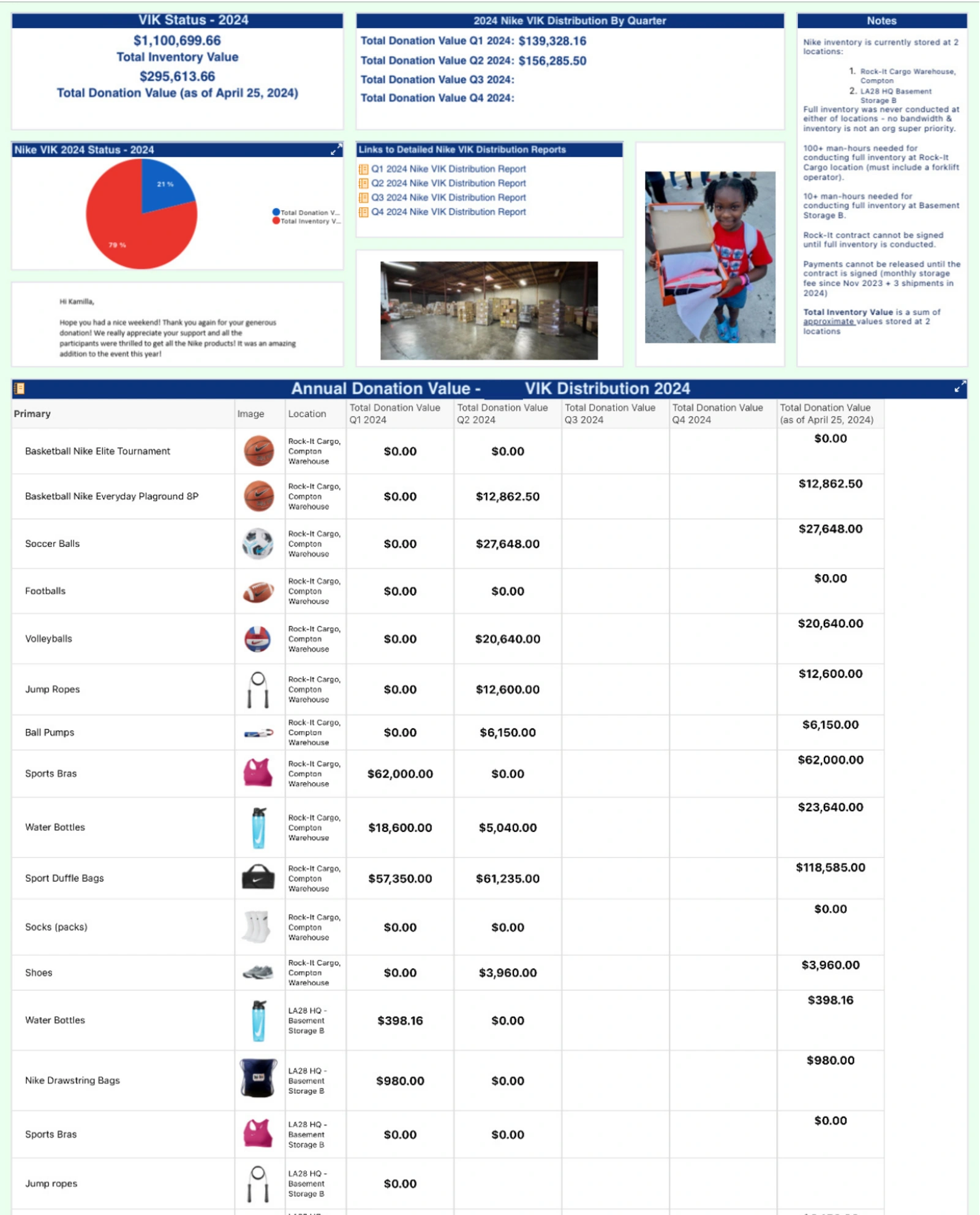
After: Inventory Distribution Dashboard
A single operational view for inventory value, warehouse locations, quarterly distribution reports, and item-level donation tracking across Los Angeles facilities.
Existing tools became one operating stack.




Integrated Operating Stack
The dashboard gave existing enterprise systems a shared operational view for inventory, value, and distribution decisions.
How the inventory became actionable.
Inventory Intake
Equipment is captured with item type, quantity, warehouse location, and value context.
Value Rollup
Inventory and donation values roll into one dashboard instead of staying scattered.
Distribution View
Quarterly reports turn available equipment into a coordinated community plan.
Community Impact
Youth organizations receive equipment while warehouse pressure drops.
Scale is a coordination problem before it is a hiring problem.
High-growth enterprises, civic organizations, and major sports initiatives face significant operational ceilings when physical assets, vendor contracts, and partner distribution depend on ad hoc tracking and fragmented institutional memory. Scaling capacity does not always require adding headcount; it requires establishing central operational architecture.
I design and deploy resilient operational infrastructure that turns fragmented real-world logistics into unified, dashboard-backed tracking systems. By leveraging existing enterprise tools, organizations gain real-time visibility, eliminate operational friction, and execute multi-million dollar distributions with precision.







The Discipline to Scale
I bring an Olympic athletic background to fuel the relentless discipline required to execute, a deep research background focused on hyper-targeted strategy, and the grit of the immigrant experience. I rely on hard analytics and behavioral strategy to build resilient operational systems that help businesses actually run.